

Dear Christian,
I write to convince you of one thing: your imagination is vital to your relationship with God. And there are very real forces which seek to steal your imagination from Him.
Wake and see! Brick by brick, a fortress has been built around the collective imagination of our culture. It is built by our algorithms and our entertainment; and the walls are a prison. The imagination of the Western mind has been kidnapped.
Each day an onslaught of dreadful news reports assaults you. It stokes hatred and proclaims apocalypse upon you, your family, your future, and your cow. We doomscroll on and on.
Social feeds itch at you. They demand your attention and draw out your most envious spirit - the one that makes you say, if only I had that life instead of my own. We are addicted.
Every four years we are tossed and whipped about by politicians’ claiming doom or salvation. And we are blinded by the wool.
An epidemic of pornography ensnares 2.14 BILLION people — and it creeps into literature through the “spice” of Romantasy novels (2 of the top 10 bestselling books of all categories on Amazon as of March ‘26 are Sarah J. Maas books).
I don’t write this to be yet another voice in a bustling bazaar where every vendor sells doom. Rather, I want to call attention to how often imagination is in the driver’s seat. Not reason. This is imagination: tortured and twisted and turned against you.
“The language of the imagination can never be inert; as with every living force, you must learn to handle it or it will handle you.” - Dorothy Sayers, Letters to a Diminished Church, p44.
This is seen vividly in Sayers’ own time, when the storytelling of a charismatic man incited the imaginations of one race of people against another.
Storytelling is at work on you. Imagination is your faculty of meaning: aesthetic stirs emotion deep within; narrative is the means to understand the story of You.
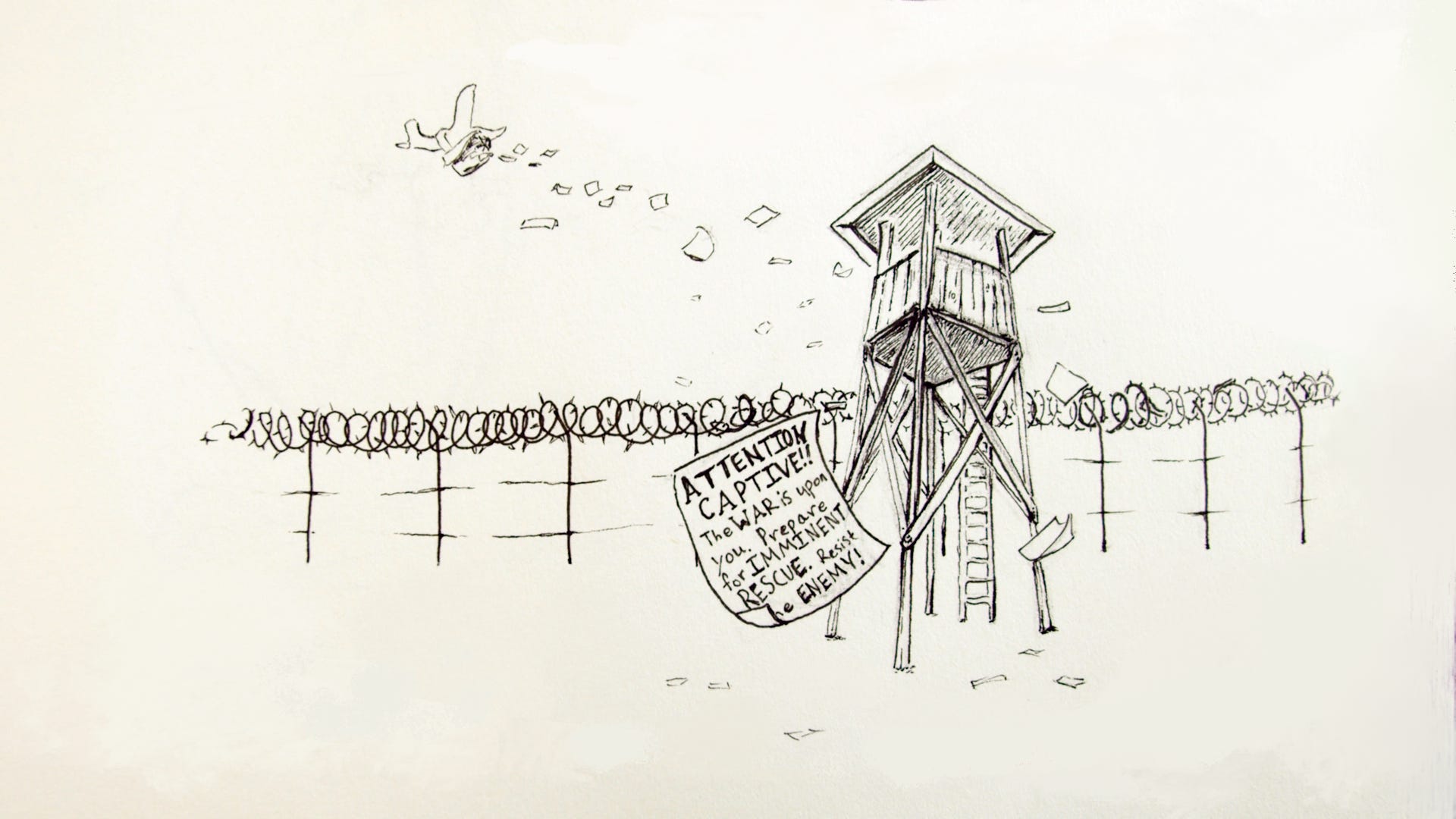
But what happens if the imagination you were given is turned against you? What if there are, right now, hundreds of thousands of demon-like prison guards that have built a fortress to trap us in addiction, distraction, annoyance, and every other possible barrier to keep us AWAY from the free imagination dwelling on Christ?
Wake! See the dark tower that has imprisoned the imagination.
The Imagination Stokes Desire
The imagination tells us what a future means to us. And what it means is inevitably what leads us to run to or away from that future.
Suppose a desire is a flame. Imagination is the fuel with which we feed the fire. Take advertisements: they are imaginative (aesthetic or narrative) arguments. They work on your imagination to suggest a future in which you are living your dream in that $500k house.
Imagination stokes desire.
A Note from Professor Duck
Our dear duck is grieved to be away for the first two installments of this series.
He and his family are currently away (some top secret business — or else vacation, I can never get it out of him). But he thought the readership may be interested in where this roadtrip of essays is headed. The destination? To the source of all imagination: none other than the One who created us by imagination, and on whose imagination we frolic and depend upon for the moment-by-moment upholding of Existence.
Imagination is powerful not because it makes us to behave either poorly or properly — but because it’s part of how we desire God. It’s how we can know Him, as fruits of His imagination.
“Imagination fuels your relationship with God. Without it, you cannot even think about God, let alone love Him.” - Professor Duck,
Undisclosed Location (probably the Grand Canyon).
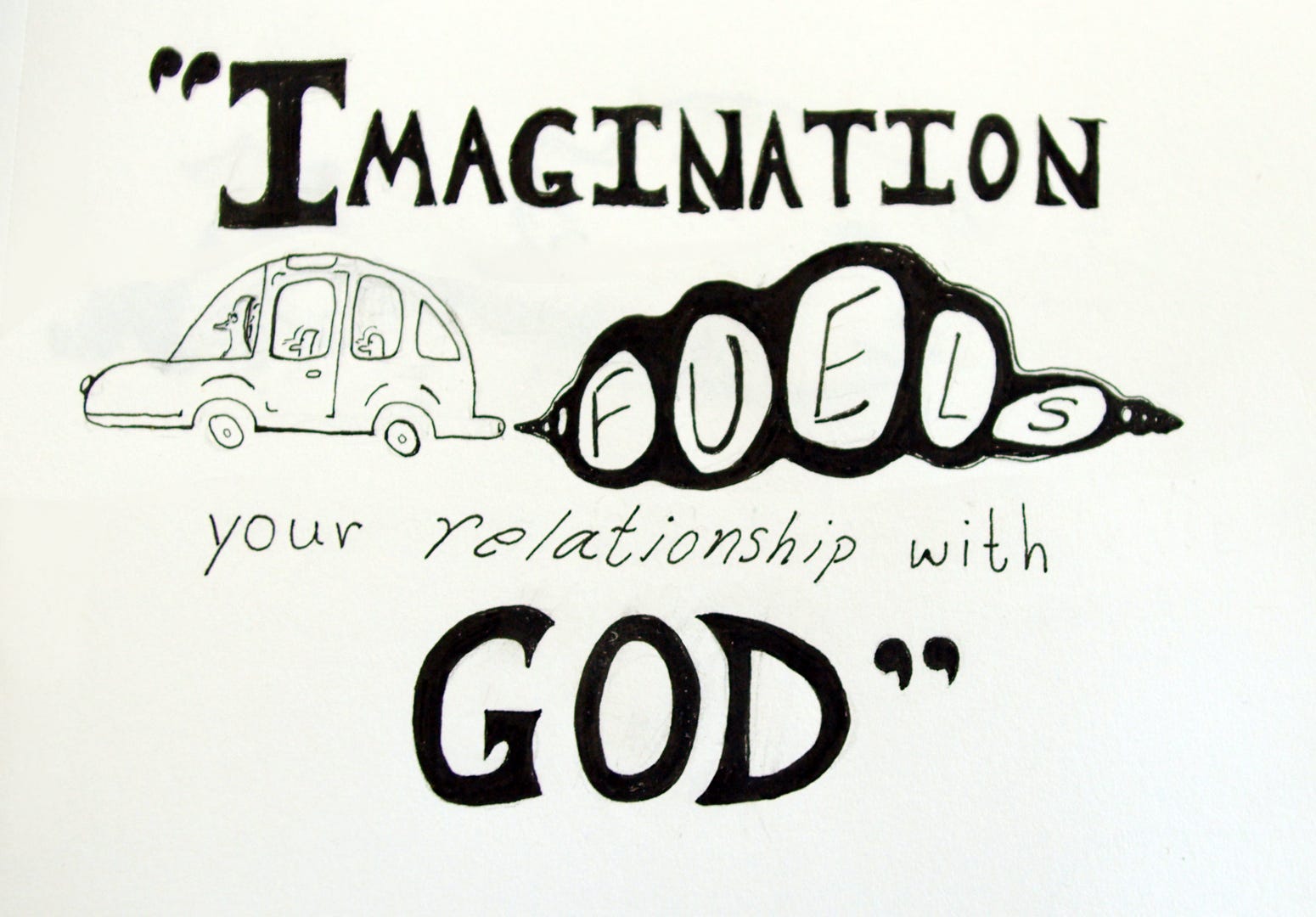
(P.S. Professor Duck assures me that he will be sending postcards via the United States Postal Service (Duck Dept.) until his return two weeks from now.)
Imagination Reframes
Now, if the imagination stokes what we desire because it shapes our understanding, it can also re-interpret how we see the past.
Take the plight of a beleaguered employee. When she works hard, the most natural thing in the world is for her to think, “This is hard; maybe it is harder than what everyone else is doing.” And then she looks around to her coworkers and sees Mr. So-and-so on break, and Mrs. This-or-that doing the easy job, and then she thinks to herself, “I’m always left with the hard bits.” And after a few years of this refrain, it has crystallized itself so hard onto her glasses that she cannot see Mr. So-and-so without seeing sloth, and all his hard work is easily overlooked, and every time she sees Mrs. This-or-that she’s manipulating her Project Manager to assign her the easy jobs.
Thus the narrative of imagination with which a person sees his or her coworkers will change how he or she acts towards them. It can lead to bitterness — or it may help restore past grievances. As Dr. Curt Thompson says,
“All healing begins with an expansion of the imagination.”
Imagination is a Rosetta Stone to interpret the past and present.
The Rescue of the Imagination
Every one of us needs a rescue of the imagination. Perhaps this is a meaning to “renewing our minds day by day.” Too many people are locked in dark, oppressive dungeons. Even the Church is full of the languishing: slaves of addiction or self-harm, shackled by the interlocking of imagination and chemical imbalances. Still others are simply unaware that the imagination is what the Devil is greedy for, shooting through every advertisement, bleeding through every social post, jittering up every ill-formed anxiety.
The good news: there is another story. It is one that shatters chains and blows up walls. It is a rescue story. And the Great Jailbreaker is not satisfied to let us rot in our cells. Indeed, He’s already airdropped pamphlets all across the prison. We believers were given a chronicle of the most important imaginative work that has ever been written: and it happens to be true — and unfinished.
The mechanism of knowing that which we cannot reason through is the topic of next Sunday’s essay: Is God Imaginary?


