Hardship and Whimsy (as explained by a duck)

My friend: the Duck
Today I have the pleasure of introducing a guest lecturer to Ransomed Imagination. This is my friend, Professor Duck!
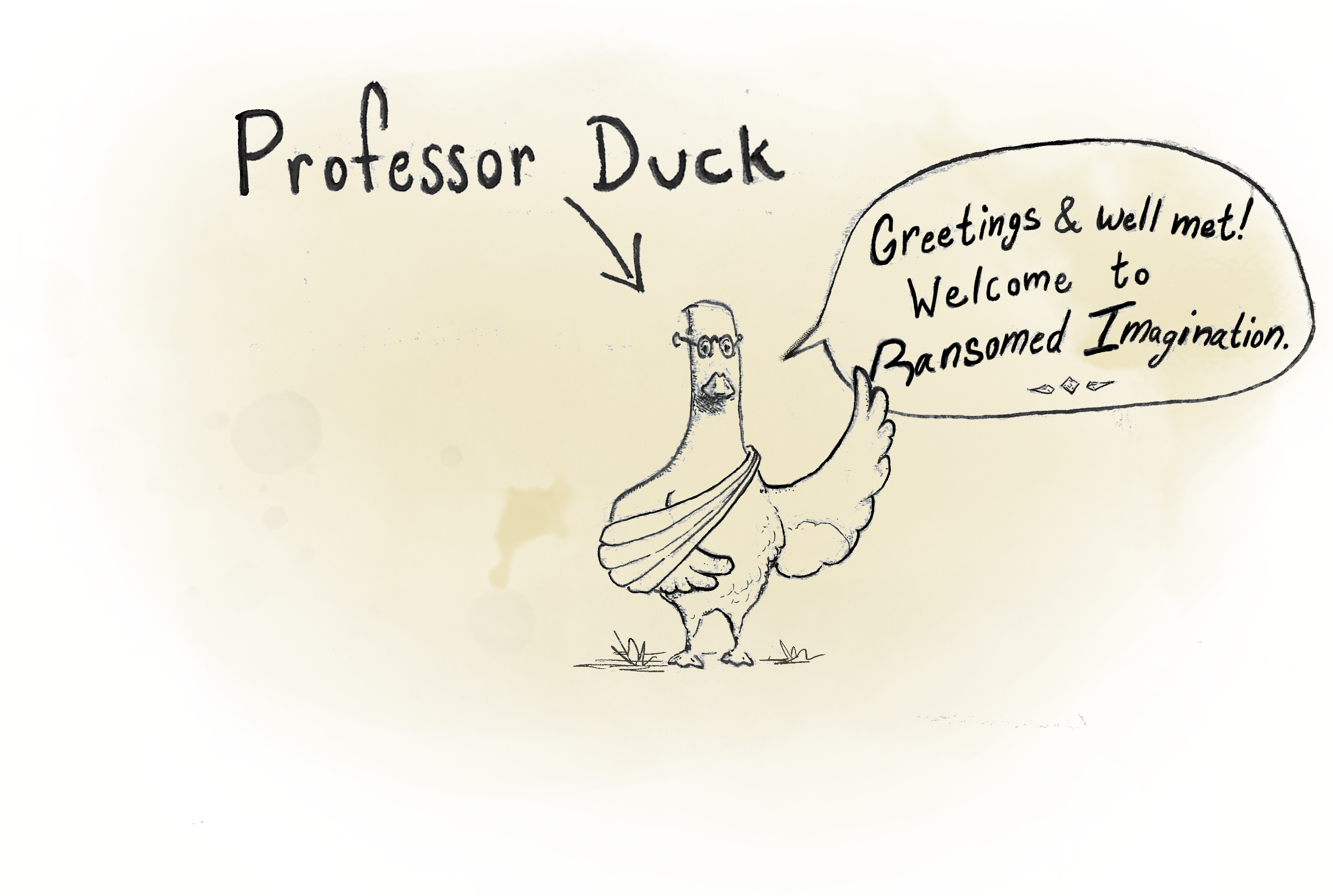
The Duck is a scholar of myth and Classical Literature who has studied Old English and Latin at Oxford. For several years now, he has migrated to England for the school term. In fact, the Duck was flying back to the U.K. to finish his PhD when an untimely north wind and a misreading of signage led him to crash-land in a quite different Oxford - this one in Pennsylvania. A broken wing has prevented him from returning until next year. Yet, his spirits remain unflagged. He saw the accident not as an interruption but an intermission, since he and I have become good friends since his arrival in my cottage garden.
Professor Duck made his landing at the crucial time, as all ducks are wont to do (ducks, as a rule, land precisely when they mean to. They share this in common with wizards). This leads to his thesis statement:
“In every time of great hardship, look for the ducks.”
So it was that the Duck came at the height of an unexplained illness which was causing me distress. Weariness, head-to-toe rashing, hair loss, arthritis, and itchiness. (Ah, the itchy dreadful! I will censor myself to this brief, insufficient description for the well-being of squeamish readers.)
My distress peaked from August through October. I had no knowledge of when or if I could find a solution to the mystery ailment. Later I would discover that I had an autoimmune disorder which had staked its claim upon every inch of me (except the bottoms of my feet and hands, mercifully). So much for my bellicose immune system.
Broken wings or itchiness, the temptation is to look at hardship and bemoan it, or else to try to resolve it as quickly as possible. Except, sometimes the only thing you can do is live with it. So the question becomes how?
How will I live with unexpected, undeserved, and (seemingly) ill-timed hardship? How does one “rejoice always” in this?
The sagacious Duck taught me part of the answer.
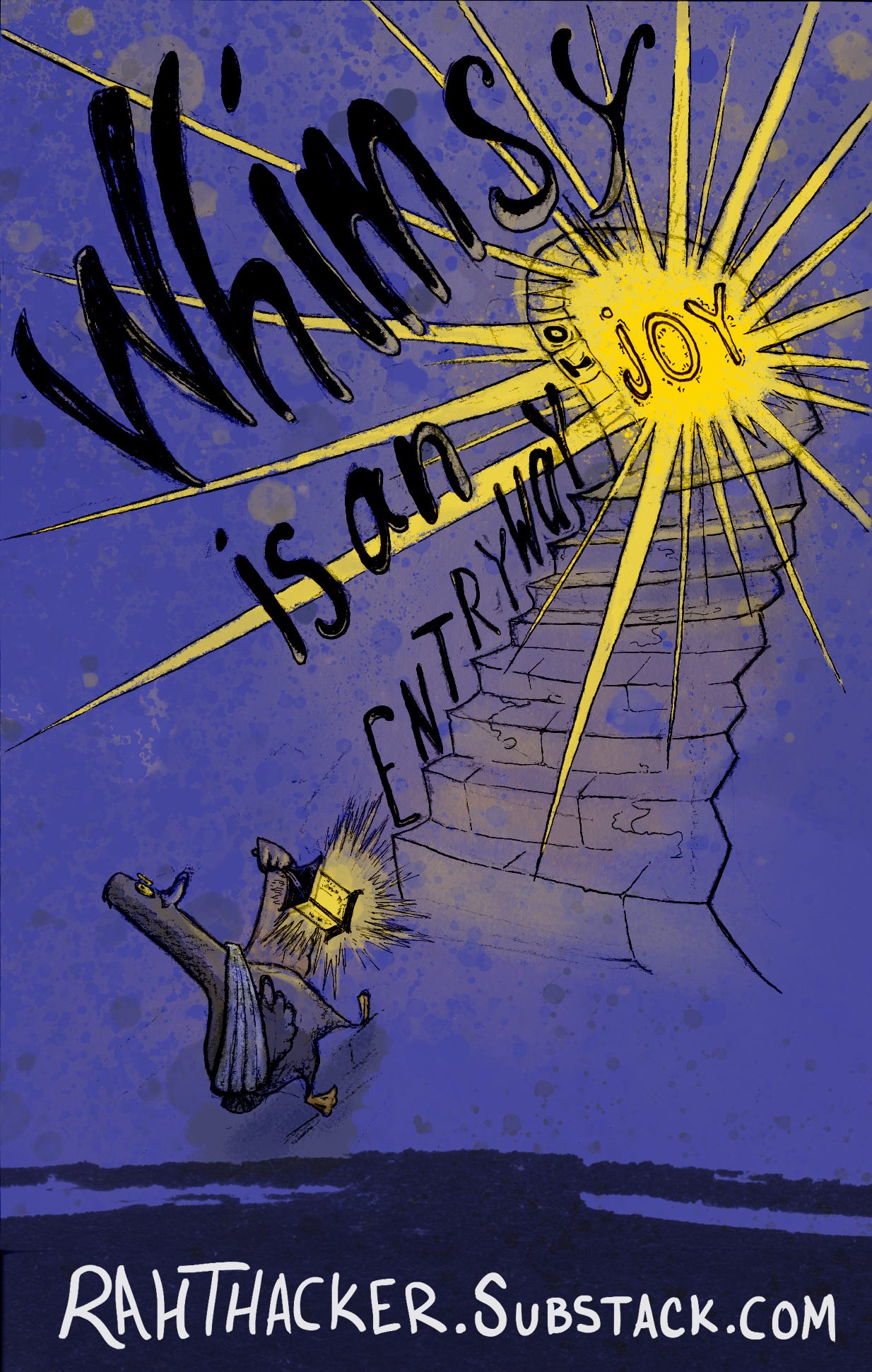
“It must be done with the utmost whimsy. Whimsy is an entryway to joy in dark times.”
“What?!” cry my detractors (chief among them Robert Thacker of 3 years ago). “But this is a SERIOUS publication. You cannot bring such silliness here. All your readers will think you’ve gone off your rocker and (even worse) Unsubscribe!”
The Duck says otherwise. He says that taking silliness seriously is just the medicine for the disorder of my spirit. It helps me to live with unreserved joy in the face of hardship.
Too often, when we weigh the odds, we bet too much on our hardships, and not enough on the joy which can trounce all the hardship in the world. We take our pains too seriously, and our play never serious enough.
The Duck Barometer
I first began duck drawing as a momentary distraction from my physical distress. Then I decided that the Duck deserved to have a picture of him drawn every day (Success rate: ~50%). But being silly takes time, so I think of it as “The Duck Barometer.” It shows when I am living at a healthy speed. That’s because drawing ducks is not productive in any way. It isn’t a quota to meet. It isn’t a madding pressure to Be Productive.
It is a practice in whimsy. It is intentional joymaking. It shows how much margin I have in life.
The Duck would like to make a sidenote here, not on whimsy but on how broken wings or unlooked for diagnoses are under the authority of Providence.
“They may be to our benefit, if our previous course was headed west when we really ought to be headed east. In that case, the only progress is to stop and turn about!”
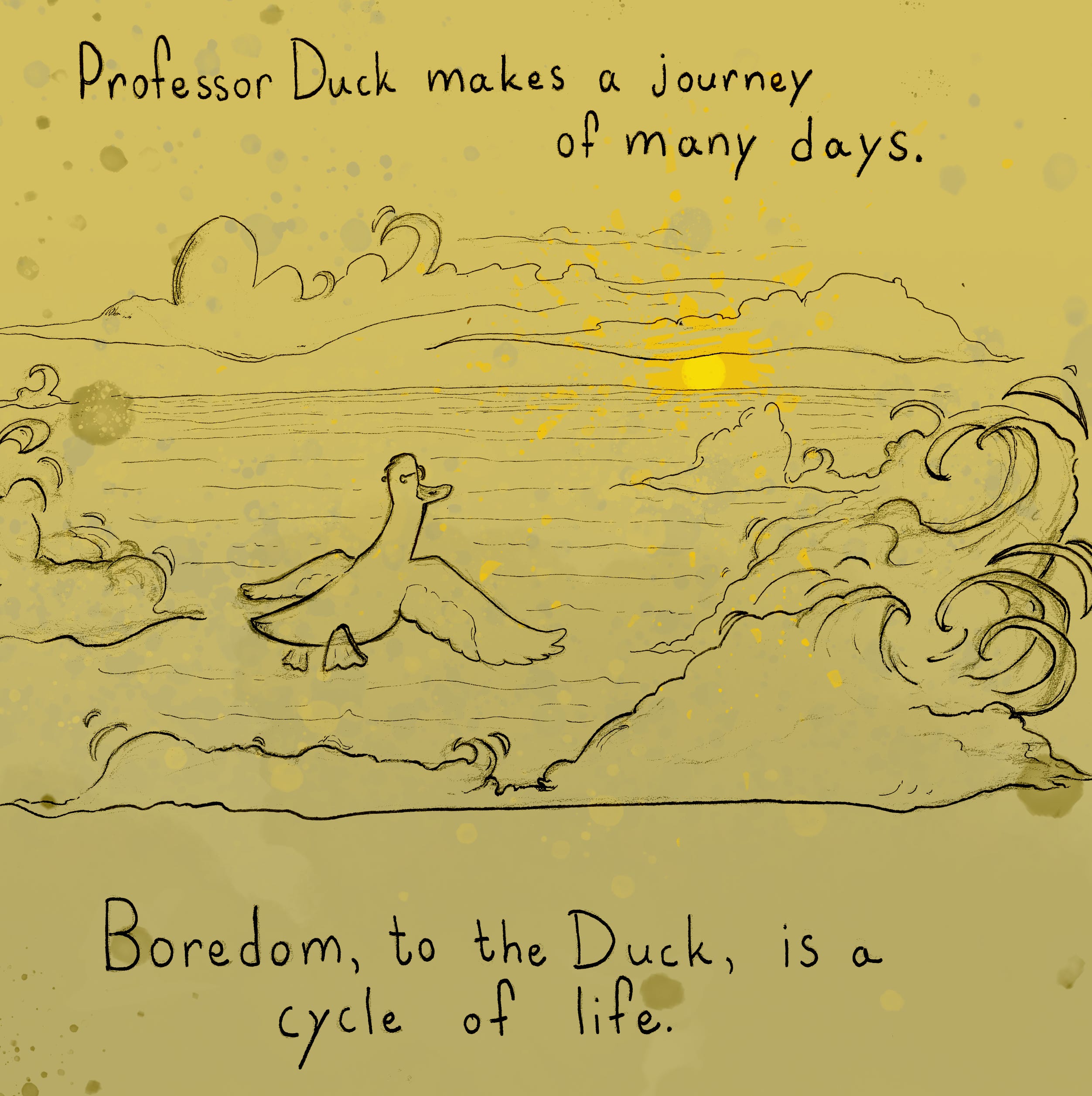
Indeed, margin is necessary to living artfully. While Professor Duck has had intense periods of study at Oxford and devotes himself to learning and creating, his life is balanced by flights of a thousand miles. During migration, the Duck will journey days on end with only the winds to navigate, endless ocean below, and his thoughts to ponder. Boredom, to the Duck, is a cycle of life.
Similarly, I’ve been stuck in more doctor’s waiting rooms in three weeks than in the previous three years. These times appear, on the outside, dreadful. They are not. They are forced speed bumps. I’m just sitting there. Might as well think something interesting while I’m at it. It’s done me good, because margin is essential to healthy bodies and abundant creativity. Praise God for waiting rooms.
And now back to whimsy.
Silliness is Worth Your Time
“Go into life armed to the teeth with silliness.” - Prof. Duck, “A Treatise on Living Artfully”, pg 9.
Time to be whimsical (that is, to crack the door to the whelming flood of joy) is not optional. I live a shriveled husk of myself if I don’t let it in. The experiment to draw the Duck every day is an endeavor of serious silliness. It is the unnecessity of it which makes it right.
That’s because I find it hard to justify intentional silliness. But silliness, in the sense of being playful, curiosity-driven, and generally alive and not an automaton, is part of being creative. There ought to be a thesis on how the Bible supports this idea, but here it is in short:
The concepts of wisdom, play, and creativity are linked. Wisdom, the character as written in scripture, is a foreman (”master craftsman” or amon אָ֫מ֥וֹן) who is side-by-side with God in the Universe-construction of Proverbs Chapter 8. In this generative act, Wisdom is helping, too. She rejoices before God (Proverbs 8:30-31), delighting God and being delighted by Him. Rejoicing (məśaḥeqeṯ מְשַׂחֶ֖קֶת) is in a whole family of ideas about playing music, celebration, laughter, imitation, even mockery. Interestingly, the word is a close relative of sachaq (שָׂחַק), or the frolicking of the sea monster Leviathan. Wisdom is at play when a craftsman is creating. Neat.
“Whimsy makes weightless our labors.” - Prof. Duck
Resisting Despair
One more thing. I’ve been smacked in the face with a serious disorder, and what will I do with it? Rejoice. Celebrate, play, laugh, frolic, because that delights God. I will live with wild whimsy. I shall resist despair, for it has no claim on me.
The Duck came to me to distract - but he was not the kind of distraction that numbs. Actually, the Duck was a distraction away from fleeting pain into a bright whimsy which is the strength of giants, for it says, “Yes, I am in pain. But this pain is fleeting and my Creator’s goodness is permanent; I still have reason to be joyful. In choosing whimsicality during hardship, maybe both God and I will meet delight.”
Closing Remarks
The good Professor is receiving treatment, and so am I. It will not be long before he takes to the skies again to return across the Pond. He is eager to finish his PhD on Waterfowl Symbolism in Mythology and Ancient Texts. I will miss him, but he has promised to return. Do comment if you would be keen on another Professor Duck feature here at Ransomed Imagination (he would be ever so pleased).
FFN (farewell for now)!
P.S. How have you have brought intentional joymaking into your life? I look forward to reading your thoughts!
I demand new publications from the Professor. He makes many quacking good point.
Sorry to hear about what you're dealing with, Robert. I know firsthand that chronic illness is not fun. Will be praying for you. But I enjoyed this piece. Great writing as always! Might we see a collection of daily duck comics come together at some point? :)