

Can the Imagination Lead to True Understanding?
Last week I asserted that your imagination is crucial for your relationship with God.
Am I saying that relationship with God is just imaginary? We must clarify what we mean by the word imagination.
Have you ever heard a friend say, “It’s too good to be true”? Sometimes, the truth is better than we can imagine, as in, “I could never have imagined it!” Or even disbelief: “I just can’t believe it.”
We must be able to imagine the world as it actually is, if we wish to live in the world as it actually is. And it is in this sense of the word “imagination” that I am proposing we must imagine God. It isn’t that God’s existence depends on us sustaining Him by imagining Him, but rather to live in relationship to Him fully we must engage ourselves fully with Him, including our imagination. In this context, imagination does not mean “unreal, fanciful, or just imaginary”, but rather is dealing with “that which we can grasp.” We can only grasp things if they fit into the narrative with which we make sense of the world.
Two distinct meanings of the word imagine: one creates. This is generative imagination. The other grasps. A year ago I was given a shock of news that a friend had suddenly passed away. I might’ve fairly reeled from it and said, “I just can’t believe it.” Disbelief or denial is the first stage of grief. I couldn’t imagine it to be true, even with the facts presented.
The imagination that creates may be described in the phrase, “I imagined a turquoise elephant with laser beams for eyes.” Or, “I had a dream last night.” Imagination that creates is full of things that cannot be, or are not yet. Imagination that grasps is full of things that are, or were, or might be.
The imagination that grasps is attempting to synthesize, to fit new shapes into the puzzle-picture of your life. This does not mean that the imagination is always true; but it does mean that the imagination is one way to see and handle and digest truth.
Without imagination, the truth cannot be fully known.
Imagining the Unseeable
It’s easy to imagine what you’ve already experienced.
A small child cannot imagine ice cream until he or she has had it. Then the child will go on dreaming about it constantly: yet only because the child’s imagination has expanded to include such delights as ice cream (this ties in with desire: see last week’s essay). (Also, giving up gluten, dairy, and red meat is only hard for me because my imagination knows what they are and therefore commends these things to my intellect. Silly imagination!)
Now, how do you imagine something you haven’t yet experienced? It’s impossible! At least, impossible to do it perfectly. What we find is that scripture is full of language which takes what we do know and uses it to bridge out to what we don’t. “The Kingdom of Heaven is like yeast that a woman took and mixed into about sixty pounds of flour until it worked all through the dough.” “And I heard a sound from heaven like the roar of rushing waters and like a loud peal of thunder. The sound I heard was like that of harpists playing their harps.”
Whatever these (seemingly contradictory) things are actually in reference to is hard to describe - because our experience is too limited to grasp them. That’s why Jesus and John used metaphors. This is how we gain “Eyes to see, ears to hear.”

*We need a source of light to illuminate the real world, which we’ve mistaken for all the shadows.
And this is why relating to God can feel so hard. He is not the same as anyone we have run into.
Picture a color that doesn’t exist.
Describe a completely new flavor to a friend who hasn’t tasted it - without likening it to any other food.1
Pretty hard, right?
The best way to introduce someone to a sound they have never heard is to say it is like another one which they have heard (this is usually much more effective than describing it via technical language, unless we are talking to a musician or audio technician who is catechized in the language of frequencies).
You’re a human being with a small and frail grasp on God. Be patient with yourself. It takes a long time (lit. a lifetime) to grow an imagination into accurate knowledge of qualities like grandeur, redemption, and steadfastness. Then imagine they are a person. We need images, feelings, aesthetic, and narrative to be stricken by God’s character. The imagination is the muscle we must use to know who God is, not just the facts about Him. It is an atrophied muscle for many of us. Let us exercise that muscle as a weightlifter devotes themself to the gym (this is the expansion of the imagination which I’ve referred to in the essay Artists are Evangelists). To know God is hard work, because He is beyond us. And that hard work that must be done is imaginative work.
“What comes into our minds when we think about God is the most important thing about us,” according to A.W. Tozer. What we think about God - who we imagine Him to be, and how we see His story we’re in, must be fought for. There are many rival imaginings. So, in our devotional meditation each morning and as stray thoughts run through our mindfields, imagine God rightly. Be informed by His story every day.
Every Christian must be searching for the True Color of God. Reject the limp, pasty image of God and embrace the colorful one.
Care must be taken here. Imagination, as we said before, has two meanings: Creating and Grasping.2 In the attempt to imagine God, do not confuse the two. He has already created us in His image; we must not attempt to create Him according to our own. The result would do no change to Him, but it would hurt us. Who we think God is does a great deal to shape who we are, right or wrong. If a Christian thinks Jesus angry, he will be an angry Christian; if he thinks Jesus soft, he will be a squishy Christian. If the Christian believes God to be a pale and limp God, he does not change to God. But he will be a pale and limp Christian. We must search for the true and living God to see Him in Full Color.
In next week’s third and final essay, we’re examining scripture to see how to practice imaginative relationship with God.
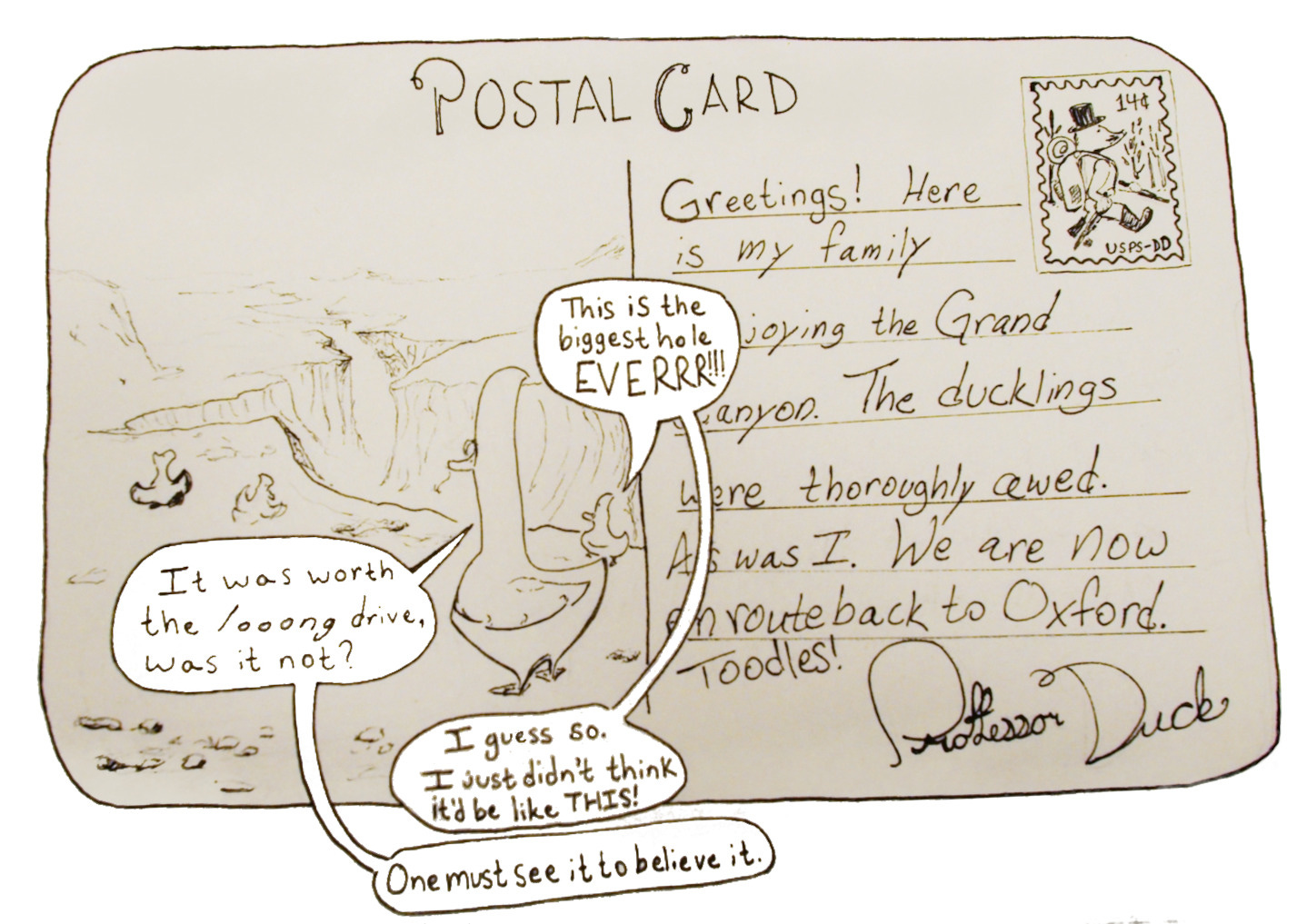
P.S. Professor Duck hopes that you enjoy his postcard, and wanted the “Dear Readership” to know that he and his family are en route back to Oxford for next Sunday’s essay.
Breadfruit, my latest culinary fascination, is described as being like potato or bread. And it does remind one of it - but it’s flavor is not Like Potato. It is its own Breadfruit Flavor, and cannot be known fully until it is experienced.
Why do these two disparate meanings share custody of the word imagination? The creating imagination serves the grasping imagination. The creating imagination makes new metaphors and embodies them so that the grasping imagination has another step on the staircase toward knowledge, another strut of the bridge to cross the chasm between the truth of what we have experienced and the truth of what we have not (fully) experienced. They are not antithetical: they enhance each other.


